Agent Behavior Standard: A New Way to Evaluate AI Agents
Agent Behavior standardizes repeated AI agent actions. This framework makes long-running agent behavior observable and measurable across recognition, judgment, execution, and recovery.
Why Agent Behavior, Now?
Today's AI agents are running multiple steps for extended periods. But most existing evaluation methods only assess the final result, so it's hard to know which path led to that result, whether incorrect judgments occurred in between, or how errors were recovered. Agent Behavior is a framework that treats this 'process' itself as the evaluation target.
Limitation: The Fence of Outcome-Centric Evaluation
Fields where existing harness and eval worked well differ sharply from the precision of single operations. But in complex tasks requiring multi-step reasoning, outcome verification, customer support classification, etc., even the highest accuracy scores can miss unsafe paths. Conversely, even poor results can be managed well if the operational state is properly tracked.
Looking at agentic systems actually in operation, there are cases where a user's request ending in result A included incorrect references, repeated unnecessary tool calls, or skipped failed steps. Such information does not stay in a single token, so the same mistakes repeat even after the model is updated.
Core Structure: BEHAVIOR.md
The heart of Agent Behavior lies in a single file: .agents/behaviors/<name>/BEHAVIOR.md. It is composed of a name, description, and Markdown body. The body is written in sections covering intent, verification evidence, judgment criteria, execution method, recovery procedure, and failure types. The mandatory format is strict so teams can expand it freely, but the goal is to first define actions that should be commonly taken across multiple tasks.
For example, a verification action before a low-cost operation might include 'whether to verify which source to prevent pricing errors', 'whether to re-verify in which way when recall is insufficient', and 'how to recover when recovery conditions are met' in BEHAVIOR.md. This file is not system software. The system software or stack actually performs the operations, the eval measures whether those operations actually occurred, and the trace records what the agent actually did. Agent Behavior is the layer that defines 'what to consider good behavior' at that level.
Relationship with Evaluation
A major feature is that it does not force specific code or evaluation methods. Humans can review traces directly, run rubrics, or create custom evals using the same BEHAVIOR.md as a reference. The agentbehavior validate, list, explain CLIs only handle format checking and exploration, while the quality of content is ambiguously divided between humans or models evaluating each other.
Looking at actual examples, the evaluation scheme that presents existing traces as action scope and judges as true/false/na is not the only valid approach. It is common for humans to enter reviews, write structured rubrics and write them together. In other words, even with the same framework, evaluation policies can be used in various ways depending on the team.
Practical Application Points
This standard does not replace frameworks installed in every execution. It is used as reference documentation at points such as local trace inspection, eval design, prompt improvement, and action audit debugging. Examples such as pre-operation verification, outcome verification, first-pass material recommendation policy, etc. are provided, so even simple development tests can be treated as operational rules.
To adopt this standard in an operational environment, it is good to start by writing BEHAVIOR.md for a small number of repeatedly performed core actions. If you try to document all actions at once, the maintenance cost only increases. Starting from the most frequently failing parts or parts that humans need to confirm every time is practical.
Limitations and Maintenance Points
Agent Behavior covers only action documentation and evaluation standards, not actual execution environments or security frameworks. Evaluation methods are not limited to the 'true/false/na' labeling example mentioned earlier, and it is not recommended to force all evaluations into this method. For operational adoption, teams must use it together with their own evaluation policies, so caution is required.
Another point to consider is that if the action scope itself becomes outdated, the model's changes cannot be tracked. Therefore, a workflow that periodically updates the scope through traces and comparisons is required. Agent Behavior does not present answers to how to set that update cycle, but the document's own revision and maintenance burden remains.
Reference Links
Related posts
'agent-comms' — A New Protocol for AI Coding Agents to Collaborate Across Sessions and Machines
The chronic ailment of AI coding agents whose memory resets when you close a session. The open-source 'agent-comms' proposes the AHRP protocol, bundling work context into capsules to hand off to other sessions and other computers, and even supporting real-time collaboration over a WebSocket mesh. We dug into this fledgling project that made waves on Hacker News.
What GPT-6 Astra's 99.9% on ARC-AGI-3 Shows—and Hides
On the ARC-AGI-3 benchmark, GPT-6 Astra scored 62.7% on Standard and 99.9% on the Provider Adapter. As high as the score is, you have to look at the differences in cost and evaluation conditions too. This piece organizes the official results, cost comparison, action efficiency, algebraic shorthand, and why 99.9% is not evidence of AGI but merely benchmark saturation.
The open source tool teaching AI agents to 'write less', ponytail
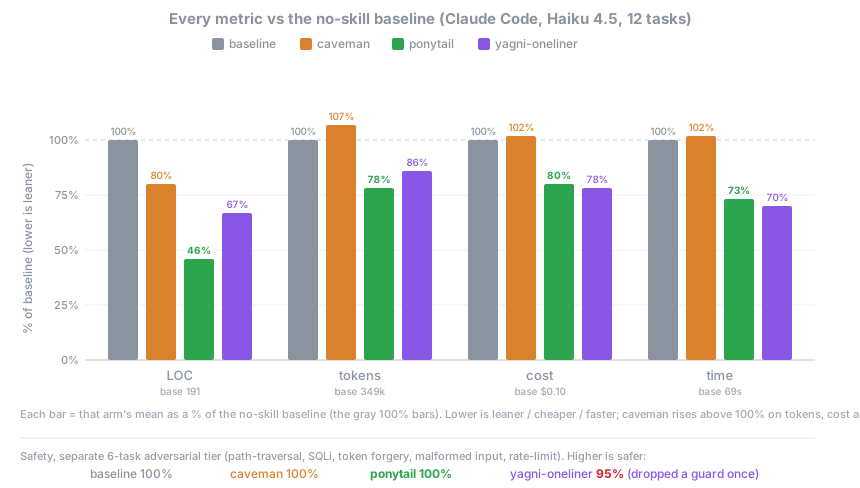
ponytail is an open source tool that teaches AI coding agents YAGNI-based minimalism. Benchmarks show 54% fewer LOC, 22% fewer tokens, and maintained safety, with install guides and tunable commands.
Written by AI from public sources; numbers and claims are checked against those sources before publishing.