Hardening LLM gateways: in-process resilience with vernLLM
vernLLM on Show HN embeds rate limiting, circuit breaking, and backoff into application code to replace an external LLM gateway. We assess its operational impact in API-heavy services.
Why this matters now
vernLLM recently appeared on Hacker News Show HN. The pitch is simple: instead of relying on an external LLM gateway, harden resilience inside the application process itself with rate limiting, circuit breaking, retries, caching, and backoff. As more teams route all LLM traffic through centralized gateways, in-process hardening offers a concrete path worth evaluating.
How existing LLM gateways work
Gateways typically expose a single endpoint per provider and centralize auth, quota, prompt filtering, and logging. That centralization is useful, but it also creates a single point of failure. When that node degrades, retries and errors quickly compound into broader LLM call failures. In multi-provider environments, routing rules become more complex, and provider-specific retry and timeout behavior often forces workarounds.
What vernLLM is trying to solve
LakBud/vernLLM presents an in-process framework for controlling LLM calls directly from application code. OpenAI, Anthropic, Gemini, AWS Bedrock, and others are accessed through a unified client interface, with retry, circuit breaker, backoff, speed limiting, cache, and backpressure as first-class constructs. The code sample shows that after creating client adapters like fromOpenAI or fromAnthropic, you configure model, backoff, rateLimit, retryBudget, maxRetries, and timeoutMs on a VernLLM instance.
This matters because it removes a network hop. Without a gateway, retry storms shrink, and callers target providers directly, so failure paths shorten. Because it is in-process, logging, metrics, and backpressure state are immediately available inside the application.
How observability and resilience actually behave
Gateway models centralize logs, which makes cross-provider tracing easier, but that log also becomes a bottleneck. vernLLM keeps state local, so only the application process sees certain circuit states. For example, an operator can tell exactly which provider's circuit opened, how long rate-limit backoff delayed requests, and whether retry storms began. That context travels alongside request context, which makes incident analysis more actionable.
Speed limiting and circuit breaking also differ in practice. Gateways usually rate-limit all provider traffic uniformly, whereas an in-process approach can apply far more granular limits. Scheduler parameters like windowMs, minCalls, and retryRatio can be adjusted at the application level before sending, which makes tuning faster during incidents.
Practical adoption considerations
This approach is not suitable for every environment. Provider keys must still be managed at the application layer, which shifts key rotation and compliance ownership into code. Providers may also change filtering, policy, or usage features that were previously handled centrally. In multi-service environments, each service owning its retry policy may work well, but it also risks inconsistent failure handling across the fleet if not standardized.
vernLLM is therefore better understood as a targeted resilience pattern rather than a complete replacement for all gateway capabilities. For teams with multi-provider fallback, provider-specific routing, and in-process observability requirements, it is worth evaluating carefully.
References
Related posts
Jev Cut Code Review Cost 45×. What About Accuracy?
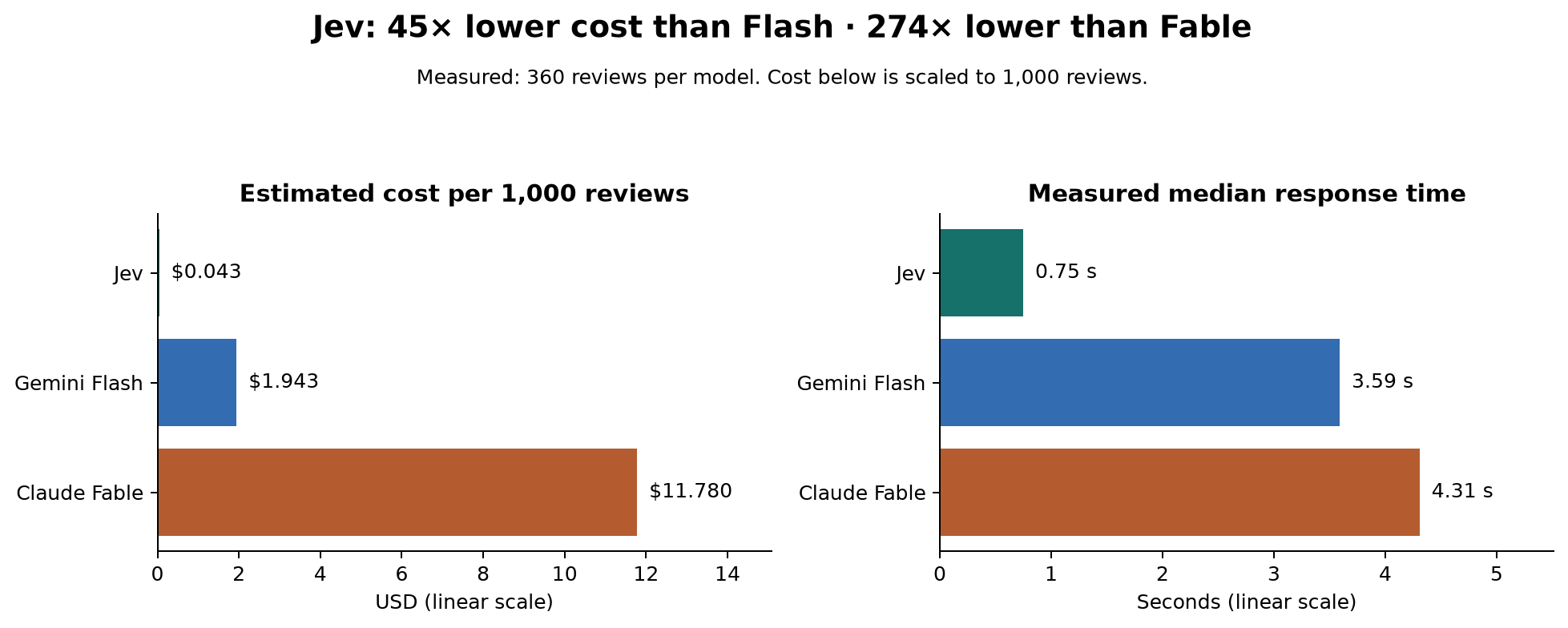
A benchmark that puts TypeSafe's System One model Jev on the same Python code-review task as Gemini 3.8 Flash and Claude Fable 5.1, comparing cost, speed, accuracy, and consistency. Jev saves 45–274× on cost and responds 4–5× faster, but takes a small hit at 98% accuracy.
'agent-comms' — A New Protocol for AI Coding Agents to Collaborate Across Sessions and Machines
The chronic ailment of AI coding agents whose memory resets when you close a session. The open-source 'agent-comms' proposes the AHRP protocol, bundling work context into capsules to hand off to other sessions and other computers, and even supporting real-time collaboration over a WebSocket mesh. We dug into this fledgling project that made waves on Hacker News.
LinkedIn Take-Home Scam: Hidden Malware
A recent case covered by AISafe was about a job offer from LinkedIn that led to malware distribution. It looked like a normal React/Web3 assignment, but obfuscated scripts were hidden in config files like `tailwind.config.js`, and further stages were pulled down during execution.
Written by AI from public sources; numbers and claims are checked against those sources before publishing.