ChatGPT and Giftedness Training Shape Student Assignments Differently
Bocconi University tested over 1,000 ninth graders: ChatGPT access improved completion, while giftedness training boosted thought diversity. Combining both yielded the strongest effects.
Looking at the Bocconi University shared research results announced by OpenAI on August 27, 2026, ChatGPT access and controversial giftedness appear to influence student assignments in different ways. An experiment testing over 1,000 ninth graders across three schools in Milan found that, contrary to the assumption that AI tools and giftedness training would hinder learning, they actually protect it in distinct ways.
AI changes the definition of achievement
The experiment used assignments from Bocconi University high school classes. Students completed competitive business assignments simulating a college entrepreneurship pitch, receiving weekly anonymous peer feedback. The first group received only ChatGPT (GPT-4o) access, the second only controversial giftedness training, the third both, and the fourth nothing. The controversial giftedness training is structured as a gamified training that connects AI and problem-solving, composed of exercises, simulations, and interactive responses.
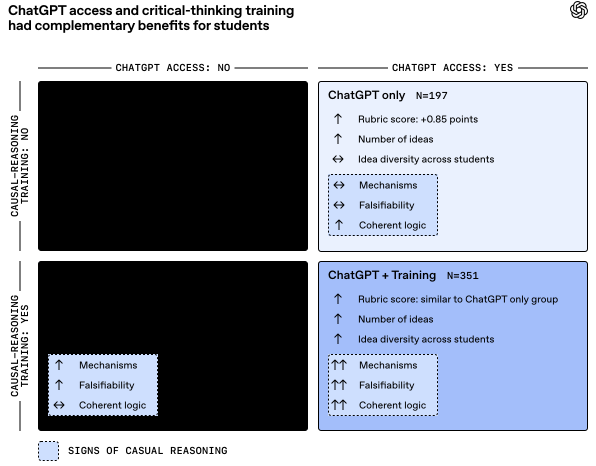
The ChatGPT access group scored around one point higher on a 10-point rubric. Responses contained more identifiers and clearer reasoning, and the actual text matched recommended structures and text diversity better. Notable was that students were not simply substituting ChatGPT for assignments; they were deciding what to research, evaluating failed responses, and choosing what to incorporate into final work. In other words, AI does not provide 'completed answers,' but alters the quality of the process students manage.
Controversial giftedness widens the gap among students
The controversial giftedness group's results were somewhat different. Students could more clearly explain why their identities were effective and where they might fail. However, conventional rubric scores themselves did not change much.
The reason is that the rubric only measured whether 'two presentation goals were reasonably met.' When researchers added automatic text analysis indicators, they found that the giftedness group included more diverse identities and provided more divergent thinking that did not mix with peers. In other words, the measurement method matters: it values 'response completeness' but overlooks the 'originality of thought.' This point is central to the study's significance.
The biggest effect when both are combined
The group receiving both ChatGPT access and controversial giftedness training showed complementary characteristics. Student diversity was most different from the giftedness-only group, and rubric scores and identifier counts aligned most closely with the ChatGPT-only group. In particular, indicators related to diversity showed the strongest trend.
Anonymous peer evaluation raises confidence in this research. It allows statistical comparison of the two interventions' independent and interaction effects. Especially noteworthy was the ability to clearly identify what changed when 'giftedness training interacted with AI.' This part is worthy of attention and separate commentary.
Changes schools need to make
This experiment is not a simple technology evaluation but a research case that upends educational methods themselves. In an era where AI easily produces high completion rates, traditional evaluation methods that only assess final answers risk overlooking students' actual improvement.
Project design and evaluation criteria must preserve the originality of thinking, reasoning processes, and diverse approaches. Claims from recent years that 'writing ability drops when using AI' may be numerous, but this research examines that premise more granularly. Writing ability alone drops completion but not originality, and giftedness training alone drops originality but not completion. When combined, both indicators appear at the same time.
Of course, the limitations of this research must be clearly stated. Because the experiment tested one short assignment at Bocconi University over one day, results may vary by school, assignment type, or evaluation rubric. Also, whether the giftedness effect is maintained long-term and whether similar patterns appear in other students or universities requires further research.
Reference links
 Source: OpenAI(2026-08-27)
Related posts
ChatGPT Ads Hits $1B Annual Run Rate Within 200 Days of Launch
OpenAI hit a $1B annual run rate for ChatGPT Ads within 200 days and expanded self-serve ads to India, Europe, the Middle East, and North Africa, showing AI monetization entering a growth phase.
OpenAI Launches 8-Week Thailand AI Startup Accelerator With 10 Startups
OpenAI and Thailand MHESI launched an 8-week accelerator for 10 healthcare, wellness, and education AI startups. Each team gets $2,000 in API credits plus mentoring, leading to a Demo Day in November.
Google rolls out 'Expert Intelligence' feature in NotebookLM
NotebookLM now supports Expert Intelligence from Google Play Books, letting users query purchased ebooks directly with insights and quizzes.
Curated, fact-checked, and edited by a single operator before publishing.